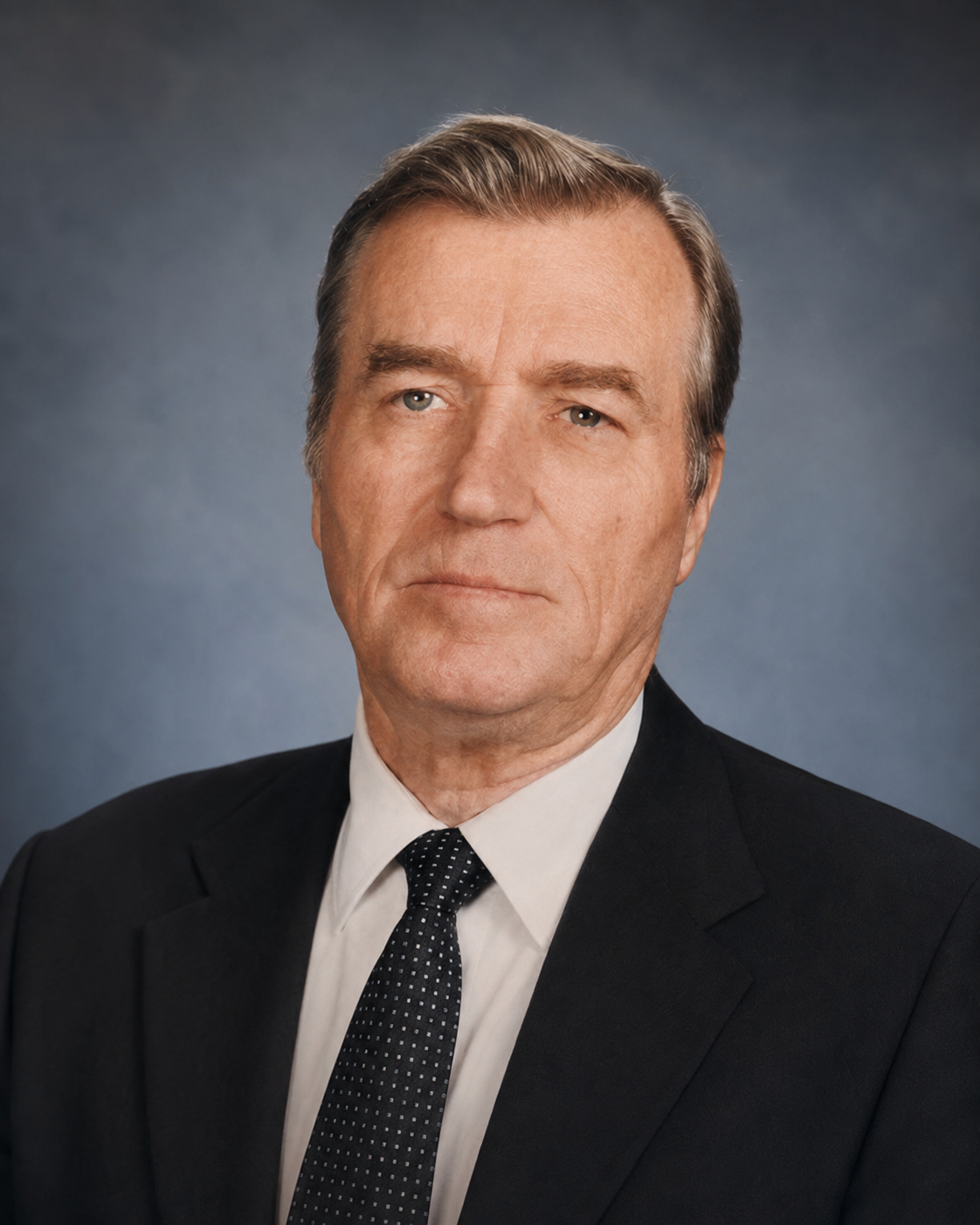
Founder
Attorney, State Senator, and Architect of Modern Horry County
1920–2002
James Price Stevens Sr. was a South Carolina attorney, legislator, military veteran, and civic leader whose career was closely intertwined with the transformation of Horry County during the second half of the twentieth century. Representing Horry County in the South Carolina Senate for twenty-one years, Stevens exercised considerable influence over education, county government, public safety, infrastructure, and economic development during an era when state legislators played a central role in the administration of local affairs.
Although commonly called “Senator Stevens” throughout his life, he was a South Carolina state senator, not a member of the United States Senate. Coastal Carolina University summarizes his legislative service as extending from 1955 through 1976, while the South Carolina Senate’s official memorial records his service as 1956 through 1976. The apparent difference reflects his election in 1955 and the commencement of the legislative term that followed.
Early life in Loris
James Price Stevens was born on April 4, 1920, in Loris, South Carolina. He was the son of M. D. Stevens and Lalla McQueen Stevens. His upbringing in the northern Horry County community of Loris gave him a lifelong identification with the rural and agricultural portions of the county, even as he later represented the rapidly developing Grand Strand and the county seat of Conway.
Stevens came of age when Horry County remained largely rural and geographically isolated. The modern tourism economy of Myrtle Beach was still developing, local roads and public institutions were limited, and much of the county’s government was effectively directed through its delegation to the South Carolina General Assembly. Those conditions would later give a long-serving county senator considerable influence over local appointments, budgets, agencies, educational institutions, and public projects.
He married Madeleine Zabelicky, and the couple raised four children. The family remained closely connected to Loris, where Stevens practiced law, attended church, participated in civic organizations, and established the political and professional base from which he would serve the county for more than two decades.
Military service
Stevens served in the United States Coast Guard during World War II. His military service placed him among the generation of South Carolina political leaders whose careers in public life began after wartime service. Coastal Carolina University specifically identifies his World War II service as preceding his legal education, while biographical directories identify the Coast Guard as his branch of service.
His later membership in both the Veterans of Foreign Wars and the American Legion reflected the continuing importance of that service in his personal and civic life.
Legal education
Following the war, Stevens attended the University of South Carolina School of Law. He completed his legal education in 1952 and served as president of the law school student body during his final year. He also participated in Phi Alpha Delta legal fraternity, the Law School Honor Council, the debate team, and Wig and Robe, the law school’s honorary organization.
Historical sources use different names for the degree he received. Coastal Carolina University describes it as a Juris Doctor, while the General Assembly’s memorial resolution calls it a Bachelor of Legal Letters. Both sources agree that he completed his law degree at the University of South Carolina in 1952. The difference appears to reflect changing or inconsistently recorded degree terminology rather than a disagreement over his legal education.
Establishing a law practice
After law school, Stevens returned to Loris and entered private practice. The Stevens Law Firm traces its establishment to 1952, the year he completed law school. His practice developed into a multigenerational firm, with his son, James P. Stevens Jr., eventually becoming both his law partner and a prominent trial attorney in his own right.
Stevens became known as a persuasive courtroom advocate. State Senator Luke Rankin, who clerked at the Stevens firm shortly after graduating from law school in 1985, later recalled watching Stevens turn an apparently unremarkable civil case into a compelling presentation that produced a substantial jury verdict. Rankin credited Stevens with an unusual ability to make jurors understand and care about his client’s position.
His legal practice included civil litigation and trial work in both state and federal courts. Reported judicial opinions identify Stevens as counsel in significant civil matters even after his legislative career had ended, demonstrating that he remained an active practicing attorney rather than becoming solely a political figure.
The same qualities that benefited Stevens in court—command of language, confidence before an audience, a resonant voice, and an ability to frame complicated questions in understandable terms—also shaped his legislative reputation.
Election to the South Carolina Senate
In 1955, Stevens was elected to represent Horry County in the South Carolina Senate. He began serving during the following legislative term and remained in office until 1976. A history of Horry County politics described him as the longest-serving Horry County senator up to that time.
His constituency and formal district designation changed as South Carolina reapportioned its legislature. He initially represented Horry County under the old county-based system. Later records place him in the 10th Senatorial District from 1966 to 1968, the 15th District from 1968 to 1972, and the 11th District from 1972 until the conclusion of his service in 1976.
Stevens served during a particularly consequential period in South Carolina history. His tenure encompassed the expansion of the Grand Strand tourism economy, major population growth, the reapportionment of state legislative districts, the restructuring of county government, the development of technical and higher education, and South Carolina’s transition from the old legislative-delegation system toward modern home rule.
Political influence in Horry County
During much of Stevens’s tenure, South Carolina counties possessed substantially less independent governing authority than they do today. Important county decisions were handled through local legislation and the county’s delegation to the General Assembly. Because each county traditionally elected a single state senator, the senator often occupied the most influential position within that delegation.
This arrangement made Stevens more than a lawmaker voting on statewide legislation. For much of his career, he was one of the principal decision-makers affecting Horry County’s governmental structure, appointments, development priorities, public agencies, and capital projects.
His rise also marked a shift in the county’s internal political geography. Horry County politics had frequently been dominated by Conway, the county seat. Stevens demonstrated that a candidate based in Loris could assemble support across the county and hold the Senate seat for more than two decades. Senator Rankin later recalled that Conway had initially been difficult political territory for a candidate from Loris, making Stevens’s sustained countywide success especially notable.
Coastal Carolina College
One of Stevens’s most enduring accomplishments was his role in the development of what is now Coastal Carolina University.
Coastal began in 1954 as a small two-year junior college offering evening classes at Conway High School. By the early 1970s, local leaders wanted the institution to provide four-year degrees. Stevens introduced the legislation necessary to convert Coastal from a two-year college into a four-year institution.
A junior year was added in 1973, followed by a senior year in 1974. Coastal awarded its first four-year degrees in 1975. The college later became an independent state university in 1993.
Stevens discussed his involvement in Coastal’s development during a recorded oral-history interview conducted by Catherine Lewis on September 25, 1992. The surviving interview addresses his life in Loris, his legal and political careers, Horry County government, home rule, and his efforts to advance Coastal Carolina College.
In 2002, Coastal Carolina University posthumously designated Stevens an honorary founder in recognition of his role in the institution’s growth.
Horry-Georgetown Technical College
Stevens was also instrumental in the creation of Horry-Georgetown Technical College. The institution emerged during a statewide effort to expand technical education and workforce training, but its establishment required strong local political support, governance, financing, and planning.
Coastal Carolina University’s official biography of Stevens identifies him as one of the important figures in HGTC’s founding. Contemporary biographical records also show Stevens participating in the selection of its early leadership. In 1962, for example, Governor Robert McNair and Senator Stevens appointed Myrtle Beach civic leader Philip Gray as the inaugural chairman of the college’s governing board. During Gray’s tenure, the Conway and Georgetown campuses were planned, constructed, and opened.
Stevens’s support for both Coastal Carolina and Horry-Georgetown Technical College illustrates a consistent philosophy: the county’s future depended upon local access to education. One institution offered an expanding academic and university pathway, while the other supplied vocational, technical, and workforce preparation. Together, they became central components of the region’s educational and economic infrastructure.
Creation of the Horry County Police Department
The Horry County Police Department was created by legislative action in 1959, during Stevens’s early years in the Senate. County sources explain that such rural or county police departments were relatively common in South Carolina at the time; eighteen existed by 1962. Horry County’s original department consisted of eight officers and a chief who answered to a commission appointed through the county legislative delegation.
Contemporary county reporting has specifically credited Stevens with the legislation that created the department. It was established to provide law-enforcement coverage across a county of approximately 1,356 square miles, much of which was rural and located outside incorporated municipalities.
The department subsequently evolved under home rule and is now the only remaining county police department of its type in South Carolina.
The agency’s creation was a consequential and sometimes debated restructuring of local law enforcement, but its longevity demonstrates the lasting institutional effect of decisions made during Stevens’s legislative tenure.
Leadership in the home-rule debate
Stevens played a visible role in one of the most important governmental reforms of his legislative career: the establishment of county home rule.
Before home rule, South Carolina’s General Assembly and county legislative delegations exercised many functions that would ordinarily belong to local governments. The Home Rule Act was signed on June 25, 1975, and counties were required to select a new form of government through referendum by July 1, 1976.
During the Senate debate, Stevens represented the Judiciary Committee and defended the proposed standardized forms of county government. Senator James Elliott later recalled watching Stevens oppose an amendment that would have allowed Darlington County to retain a separate arrangement outside the authorized forms. The debate was remembered as a major legislative contest, with Stevens taking a leading position from the Senate podium.
His involvement carried a degree of historical irony. The old system had given powerful county senators—including Stevens—substantial authority over local affairs. Yet he participated directly in the legislation that transferred much of that authority to elected county governments. The reform helped end the political structure under which his own influence had grown.
Speaking style and political personality
Colleagues remembered Stevens as a forceful and polished speaker. Senator Elliott described him as a gifted orator with a “great baritone voice,” capable of commanding the Senate chamber during extended debates.
His courtroom and legislative styles appear to have reinforced each other. In both settings, he relied on narrative, personal presence, confident delivery, and persuasion. Rankin’s recollection of Stevens before a jury closely parallels Elliott’s description of him addressing the Senate.
Stevens also became a political mentor. Rankin credited him with offering encouragement and assistance when Rankin first sought election to the Senate. That support helped connect a younger generation of Horry County attorneys and political leaders with the networks and traditions Stevens had developed during his own career.
The 1976 election defeat
Stevens’s Senate career ended with an election defeat in 1976. The loss coincided with the implementation of home rule and the broader restructuring of political authority in Horry County.
According to Senator Elliott, Stevens responded to the defeat without blaming the electorate. In his concession remarks, he said, “the people did not leave me. I left the people,” accepting personal responsibility while expressing gratitude for twenty-one years of public service.
The statement became part of his political legacy because it reflected the dignity with which colleagues believed he concluded his elected career. He did not, however, withdraw from professional or civic life. He continued practicing law and remained an influential elder figure in Horry County’s legal and political community.
Faith and civic associations
Stevens was a faithful member of Loris Methodist Church, now Loris First United Methodist Church, where he taught the Men’s Bible Class. His religious involvement was a significant part of his community identity and remained connected to his public reputation throughout his life.
His civic and professional memberships included the Masons, Veterans of Foreign Wars, American Legion, and Phi Alpha Delta. These organizations reflected the principal strands of his adult life: military service, law, faith, fraternal fellowship, and civic participation.
Death and official tributes
James P. Stevens Sr. died on Sunday, April 14, 2002, at the age of eighty-two. His funeral was held at Loris Methodist Church.
Two days after his death, members of the South Carolina Senate delivered extensive tributes on the Senate floor. Senator Elliott praised Stevens’s leadership, character, devotion to South Carolina, and twenty-one years of distinguished service. Senator Rankin called him Horry County’s greatest senator and remembered him as a mentor, trial lawyer, political leader, and family friend.
The Senate unanimously adjourned in his memory, formally recognizing him as a former colleague, statesman, and friend who had represented Horry County from 1956 through 1976.
In 2005, Senators Luke Rankin and James Elliott sponsored a resolution requesting that the South Carolina Highway 9 bypass in Horry County be named the “James P. Stevens, Sr. Memorial By-Pass.” The Senate adopted the resolution and sent it to the House, although the Statehouse status page indicates that the measure remained in the House Committee on Invitations and Memorial Resolutions.
Historical legacy
James Price Stevens Sr.’s legacy is most visible in the institutions that continued serving Horry County long after his political career ended.
Coastal Carolina’s transformation into a four-year institution eventually helped produce an independent public university. Horry-Georgetown Technical College became a principal source of technical education and workforce development. The county police department created during his tenure remains a major public-safety agency. The home-rule reforms he helped guide changed the structure of county government itself.
His career also embodied an older model of South Carolina public service. He was simultaneously a local attorney, trial advocate, state legislator, institutional builder, political intermediary, and community leader. His power was rooted not merely in holding office but in his ability to connect Columbia’s legislative machinery with the practical needs and ambitions of Horry County.
A complete evaluation of Stevens must also recognize that he served during a period of profound social and political change. The readily accessible digital sources provide substantial information about his work on education, local government, public agencies, and home rule, but comparatively little detail about his positions on every major state and national controversy of the era. Conclusions about subjects not documented in the available legislative and archival record should therefore be made cautiously.
What the surviving record establishes is that Stevens was among the most consequential Horry County public officials of the twentieth century. His influence extended from the courtroom in Loris to the Senate chamber in Columbia and into institutions that continue to shape life along the Grand Strand. His twenty-one-year Senate career, his legal practice, his advocacy for higher and technical education, and his role in reorganizing county government created a public legacy that remains embedded in modern Horry County.
Condensed chronology
- April 4, 1920: Born in Loris, South Carolina, to M. D. and Lalla McQueen Stevens.
- World War II: Served in the United States Coast Guard.
- 1952: Completed his legal education at the University of South Carolina; served as president of the law school student body; returned to Loris to practice law.
- 1955: Elected to represent Horry County in the South Carolina Senate.
- 1956: Began the legislative service recorded in the official Senate memorial.
- 1959: Horry County Police Department established by legislative action during his tenure.
- Early 1960s: Helped advance the establishment and early governance of Horry-Georgetown Technical College.
- Early 1970s: Introduced legislation enabling Coastal Carolina College to become a four-year institution.
- 1973–1974: Coastal added junior- and senior-year instruction.
- 1975: Coastal awarded its first four-year degrees; Stevens helped lead the Senate debate concerning county home rule.
- 1976: Twenty-one-year Senate career ended following an election defeat.
- September 25, 1992: Participated in a recorded Horry County and Coastal Carolina oral-history interview.
- April 14, 2002: Died at age eighty-two.
- 2002: Posthumously designated an honorary founder of Coastal Carolina University.
- 2005: South Carolina Senate adopted a resolution requesting that the Highway 9 bypass be named in his memory.